
More about Fall Colours!
| By Johnny Caryopsis | (Click links for more images.) |
Weather Affects Fall Colours
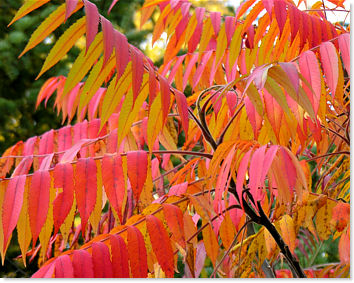 Smooth Sumac (Rhus glabra), a horticultural variety.
Colours resulting from anthocyanin production, unlike those resulting from the always-present carotenoids, can be greatly influenced by weather conditions. Cool nights with sunny days in early autumn makes for good anthocyanin production. Low, but not freezing temperatures, help slow the movement of sugars out of the leaves at night. Sunny days help produce sugars initially, then drive the process that converts sugars and flavonols into anthocyanins. A cloudy autumn with warm nights will not produce good fall colours, at least not for plants that develop red colouring.
Weather can affect fall colours in other ways, too. An early frost can help to break down chlorophyll more rapidly and bring about a more coordinated fall colour display. If the frost affects all the plants in a given region they will tend to become more synchronized in the development of their colours.
Individual Variation
Variations in fall colour between different species of plants are largely the result of their genetic ability to produce or concentrate the various pigments. Within each species, though, there can still be great variation in the fall colours produced. Some variation can be accounted for by genetic differences in individual plants, but most is likely the result of differences in the environmental conditions they experience. For example, a shrub growing on the north side of a forest bluff may not get enough sunlight to produce anthocyanins and could appear brown or yellow, while one on the south side, where it receives sunlight, might be bright red! Soil and moisture conditions and general health can all impact on the fall coloration of an individual plant.
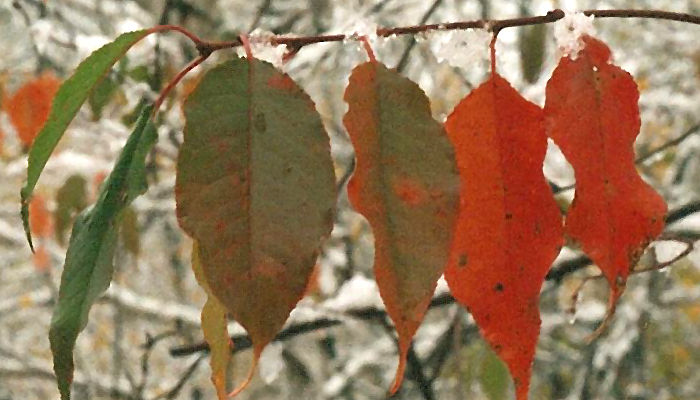
Even within the leaves on a single plant, there can be variation in the nature and extent of their coloration. Each leaf will be exposed to its own unique set of environmental conditions. Some leaves will be more shaded than others, others may be more exposed to frost or be on a part of the plant that has been damaged or is diseased. The result can often be rather striking differences in leaf coloration on a single plant.
Colour variation on a single branch: Pin Cherry
(Prunus pennsylvanica)
The Final Stages - Why Leaves Turn Brown
As senescence progresses further even the carotenoids and anthocyanins decay and their colour fades. By the time the leaf falls, or shortly thereafter, the once vibrant colours will have faded to a dull tan or light brown.
Dead leaves on ground.
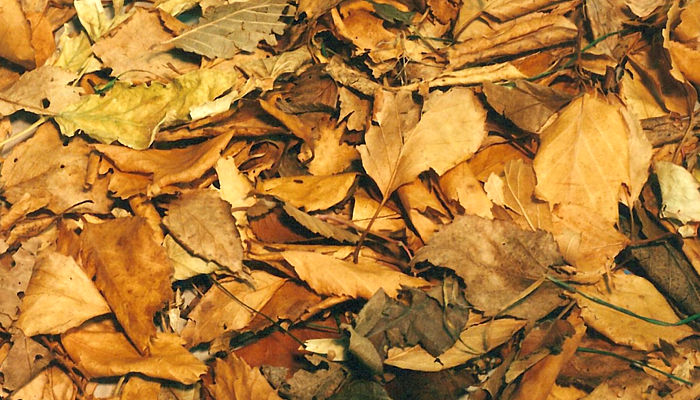
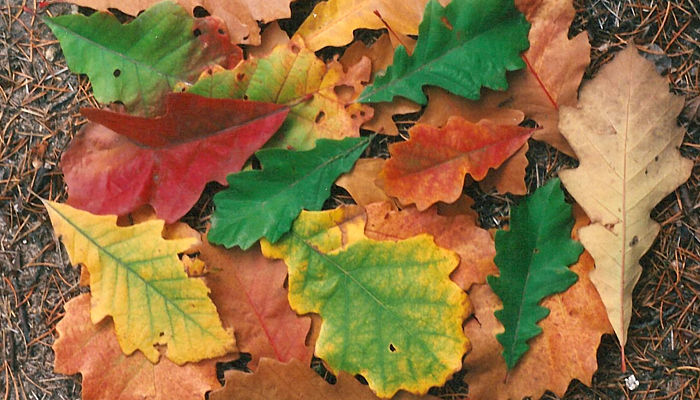
As with the other colours there are various compounds in leaves that act as brown pigments. One of the most common is tannin. Tannin and other such compounds are among the slowest to decay, giving colour to leaves even after they have fallen. Plants whose leaves turn brown before they fall often contain large concentrations of such compounds. In Manitoba, mature Bur oaks (Quercus macrocarpa ) often show little coloration in fall, the leaves turn from green to light brown, because of the high concentrations of tannin. Oddly though, in younger oaks a startling array of colours may be formed. Tannin tends not to be produced in such concentrations in seedling oaks.
Bur Oak (Quercus macrocarpa) leaves in varying shades.
Plants That Don't Turn Colourful
Ever wonder why some plants don't produce fall colours and don't drop their leaves until after the snow flies? Anyone who's seen a Siberian elm or French lilac in late autumn knows what I mean.
Siberian Elm (Ulmus pumilla) in late October.
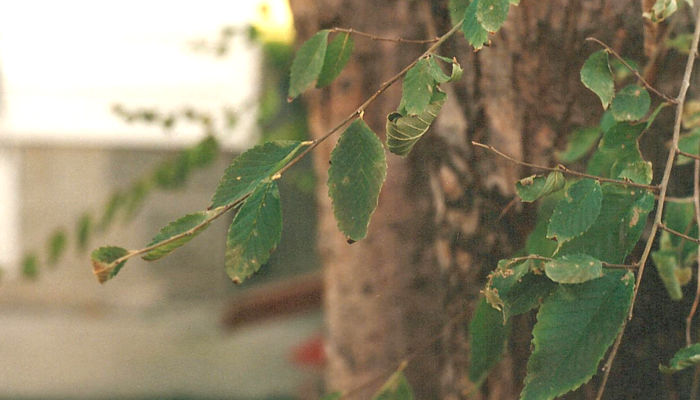
The smug answer to that question is that these plants don't belong here. Many introduced, horticultural varieties of plants are grown here in Manitoba, but they are not adapted to our climate and growing season. Fall colours are dependent on the orderly procession of leaf senescence. Senescence is triggered by photoperiod changes that are specific to the latitude and growing season where the plant evolved.
Plant species rapidly adapt, through evolution, to become "local ecotypes", closely adapted to the conditions of their immediate environment. As plants spread north after the last ice age they had to adapt to the shorter growing season and begin senescence earlier than they would further south. An introduced plant that originates too far south or from a region with a much longer growing season will be overcome by winter before it can go through its orderly shut-down. Their leaves are frozen before the fall colours can develop. They are killed by frost rather than being reclaimed by the plant, and they flutter to the ground, still green. They often hang on the trees past the first snows as the process of leaf abscission has not progressed properly either.
If you're thinking of planting a tree or shrub and want something that will enhance the fall colours in your yard consider a native species that is a local ecotype To choose a plant for fall colours you should select it in the fall to be sure it produces the colour you want! Autumn is a good time to plant trees and shrubs anyway.
Fall Colours - A Brief Summary
- Fall colours develop during leaf senescence, the gradual death of the leaves.
- There are three main factors that account for fall colours:
- The genetic make-up of the plant that determines what kind of photosynthetic and other pigments it has or can produce.
- The different rates of decay of the various pigments.
- Weather conditions influencing the production or decay of various pigments during leaf senescence.
- The genetic make-up of the plant that determines what kind of photosynthetic and other pigments it has or can produce.
- As the green of chlorophylls fades, other colours are expressed. The yellows of carotenoids, the reds of anthocyanins and the browns of tannin (and other compounds) become visible.
- Leaves fall as a result of a corky barrier being laid down between the leaf and stem. By the time of leaf-fall, the bright fall colours will have faded as did the original green colour.
A Wondrous Coincidence
Most things in nature are the way they are for a reason; evolution is a demanding master. Fall colours, however, seem to be an exception. They are not (to my knowledge, at least) adaptive; that is, they do not help plants to survive, they are merely artifacts of leaf senescence, part of an orderly shutting-down of plants for the winter. The compounds that remain in leaves and create the attractive colours are the "left-overs" that the plant could not resorb or recycle. Unlike the familiar animal signs of autumn, such as squirrels burying nuts or flocks of geese heading south, which are clearly beneficial to those species, the spectacular scenery afforded by the death of leaves appears not to have any benefit to the plants. The answer to the question of why fall colours are so beautiful lies more in the eyes of the beholders, us, than in some grand scheme of nature. Fall colours are a wondrous coincidence!
Look for Fall Colours Everywhere
Attractive fall coloration is not limited to trees and shrubs. We are most familiar with this phenomenon in woody plants (trees, shrubs & vines), but the same thing occurs in many herbaceous (non-woody) plants, too. Herbaceous perennial plants loose all their above ground growth each year and regenerate new stems and leaves in spring. Their leaves and stems go through senescence, just as the leaves of woody plants do. Many grasses and forbs (herbs, wildflowers, etc.) produce striking displays of colour as they prepare for winter dormancy. The fall colours in a marsh or on a prairie can be just as beautiful as in any forest. You just have to look a little closer!
And speaking of looking closer, take a little time and browse through our gallery of fall colours. But more importantly, get out and witness the splendour of autumn in Manitoba, in person!
Carry on for a Gallery of Fall Colours!
| You can help NatureNorth produce more great articles with a secure donation through PayPal. Our Google Adsense ads pay our server costs, but that's about it. To learn more follow this link: Support NatureNorth. Thank-you! | |
Return to: Fall Issue | NatureNorth Front page