
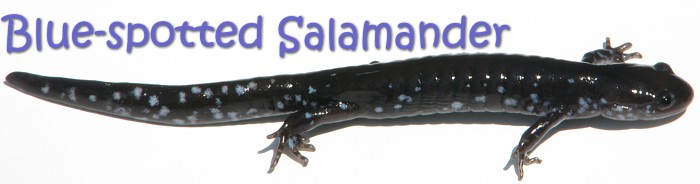
| Biology of the Blue-spotted Salamander | (Click thumbnail images for larger photos.) |
Basic Stuff about Salamanders
Salamanders are a large group (about 300 species worldwide) of tailed amphibians (Class Amphibia, Order: Caudata). They are "cold-blooded" animals, but unlike reptiles, do not bask to try and alter their internal temperatures. Their thin skins must remain moist (many species can draw oxygen in through their skin, and all draw moisture in through their skin), so most salamanders live reclusive lives, hiding under plant litter, rocks or fallen logs, and emerging only on moist nights. All salamanders are carnivorous, eating a wide range of insects and small invertebrates. Larger, aquatic salamanders may eat fish or other amphibians. Most salamanders are terrestrial as adults, returning to water only to breed and lay their eggs. Some species are fully aquatic (mudpuppies and hellbenders) and some spend part of their adult life on land, then return to the water (newts).
The word "salamander" derives
from an Arabic term meaning "lives in fire". It was once thought
that these amphibians could walk through fire, unharmed. |
Salamanders hear by sensing vibrations in the ground. They have good eyesight and a good sense of smell. Unlike their relatives, the frogs and toads, they don't produce any sounds. Many species produce noxious or toxic skin secretions as a means of defense and are often brightly coloured to announce their distastefulness or poisonous nature to predators. Salamanders shed their skin regularly and almost invariably eat it to recover the nutrients.
Description
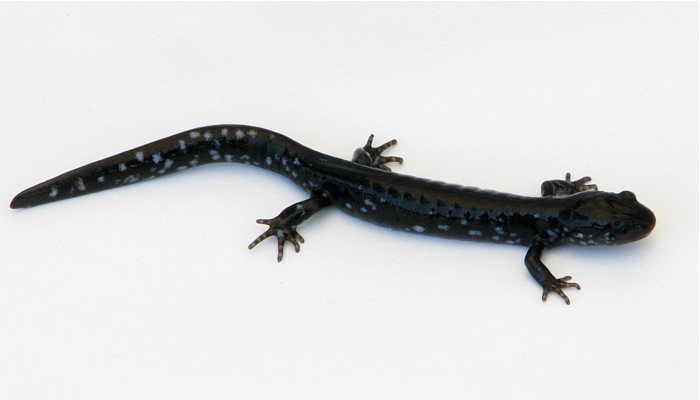 The Blue-spotted Salamander (Ambystoma laterale)
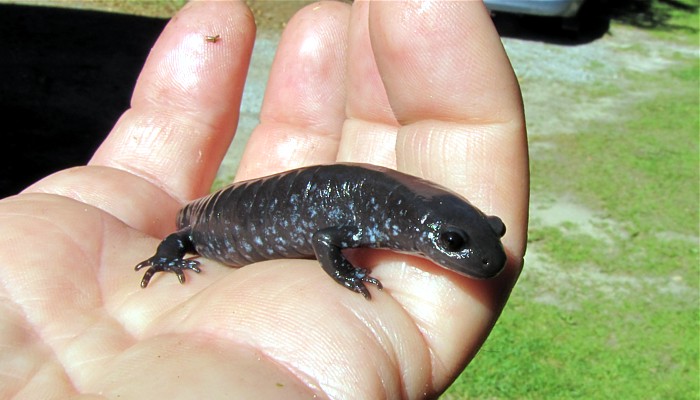
is a small critter. A large adult will only be about 12 cm long, 40% of
that is tail and its body is only about 1 cm wide. Colouration is shiny-black,
like patent leather, with dusty blue spots mainly on the sides and belly.
It is a slimmer built and much smaller salamander than Manitoba's other terrestrial species, the Barred Tiger Salamander (Ambystoma
mavortium) and the Eastern Tiger Salamander (A. tigrinum). Our other salamander, the Mudpuppy (Necturus
maculosus) is aquatic, and never leaves the water. Descriptions of these species can be found in the Manitoba Herps Atlas.
The Blue-spotted Salamander (Ambystoma laterale)
is a small critter. A large adult will only be about 12 cm long, 40% of
that is tail and its body is only about 1 cm wide. Colouration is shiny-black,
like patent leather, with dusty blue spots mainly on the sides and belly.
It is a slimmer built and much smaller salamander than Manitoba's other terrestrial species, the Barred Tiger Salamander (Ambystoma
mavortium) and the Eastern Tiger Salamander (A. tigrinum). Our other salamander, the Mudpuppy (Necturus
maculosus) is aquatic, and never leaves the water. Descriptions of these species can be found in the Manitoba Herps Atlas.
Classification
The taxonomic classification of the Blue-spotted Salamander goes like this:
Kingdom: Animalia
Phylum: Chordata
Class: Amphibia
Order: Caudata (tailed amphibians)
Family: Ambystomatidae (the mole salamanders)
Genus: Ambystoma
Species: laterale
Name Derivation
Scientific: "Ambystoma", is from the Greek "Ambyx or Ambykos", referring to a cup or the rounded top of a cup, or possibly "Amblys" - blunt; and, also from Greek, "stoma", meaning mouth. So, I guess "Ambystoma" refers to the rounded, cup-shaped mouth of this genus of salamanders.
"laterale" , from the Latin, "latus", for side or flank. Referring to the spots on the sides of the critter.
Common: The common name of this species, Blue-spotted Salamander, makes good sense. Its most striking feature is its blue spots.
Distribution
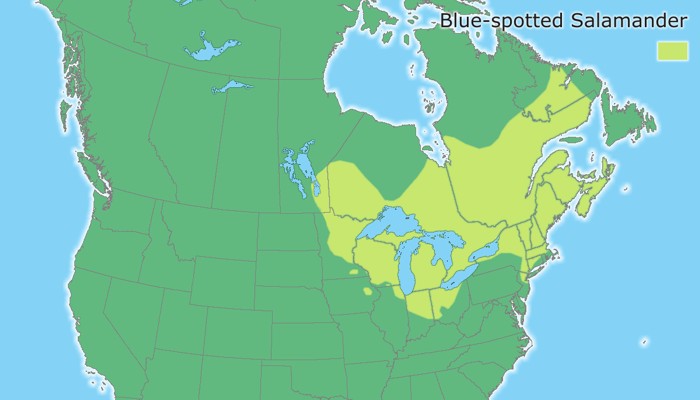 The Blue-spotted Salamander occurs in eastern central North America in
a broad band stretching from the Atlantic provinces and northern New England,
around the Great Lakes, and west as far as central Manitoba. It gets up
to James Bay in northern Ontario, but all the sources I located suggested
that the extent of its northward range has not been adequately defined.
The Blue-spotted Salamander occurs in eastern central North America in
a broad band stretching from the Atlantic provinces and northern New England,
around the Great Lakes, and west as far as central Manitoba. It gets up
to James Bay in northern Ontario, but all the sources I located suggested
that the extent of its northward range has not been adequately defined.
In Manitoba, the species is found in the southeastern corner of our province, east of the Red River and as far north as the narrows of Lake Winnipeg. However, this is a very cryptic species, and one for which intensive inventory hasn't occurred. There will likely be extensions of its known range in this province for some time into the future. (Any of you guys or gals up north ever come across a Blue-spotted Salamander? If so, let us know!)
Habitat
This is a woodland species that is probably restricted to areas of moist forest floor, near lakes, streams and wetlands in areas with mixed forests (deciduous and coniferous trees together). It breeds in ephemeral, snow-melt ponds, like those used by wood frogs, and in small permanent ponds that are free of fish.
Populations
There are no estimates available of the population densities of the Blue-spotted Salamander. It is not a widely studied species, and its cryptic nature makes it very hard to gather data. Blue-spotted Salamanders should be the focus of more research in this province. (Something the Manitoba Herps Atlas may facilitate!)
Life Cycle
Blue-spotted Salamanders breed in early spring, from April to mid-May, in small ponds. The adults emerge from winter hibernation (see below) and gather in the ponds. Most of the mating activity likely occurs at night. For most salamanders, the males use a combination of pheromones and visual displays to attract females into close proximity. The Blue-spotted has a prolonged courtship where the male holds onto the female with his front legs and rubs his chin over her head. The male deposits a packet of sperm (a spermatophore) on the pond bottom, and tries to draw the female over top of it. She then picks it up with her cloaca (urogenital opening) and fertilizes her eggs internally.
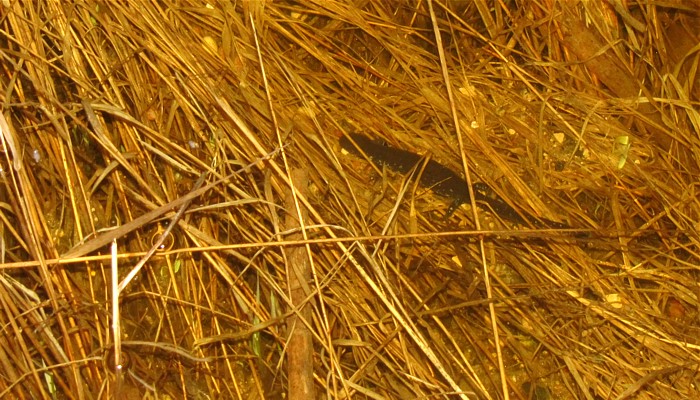 Females lay their eggs, as many as 500, individually or in small bunches
at the base of sticks, plants or rocks in the pond. The eggs take about
a month to hatch, depending on water temperature. When they hatch the larvae have well developed eyes,
mouths, external gills and a broad tail fin, so they can see, lunge and
snap at the tiny aquatic animals they feed on, such as daphnia, copepods
or other invertebrates.
Females lay their eggs, as many as 500, individually or in small bunches
at the base of sticks, plants or rocks in the pond. The eggs take about
a month to hatch, depending on water temperature. When they hatch the larvae have well developed eyes,
mouths, external gills and a broad tail fin, so they can see, lunge and
snap at the tiny aquatic animals they feed on, such as daphnia, copepods
or other invertebrates.
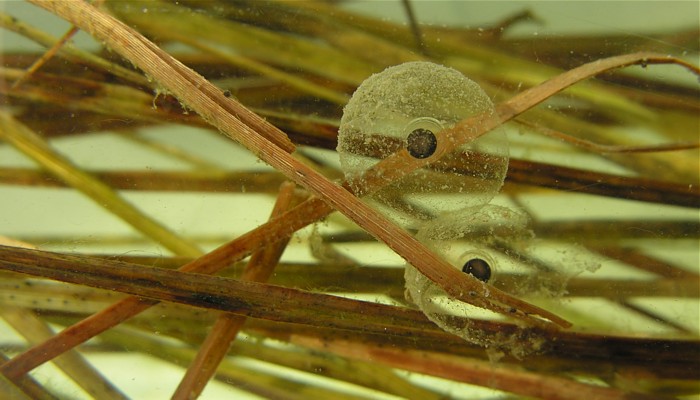
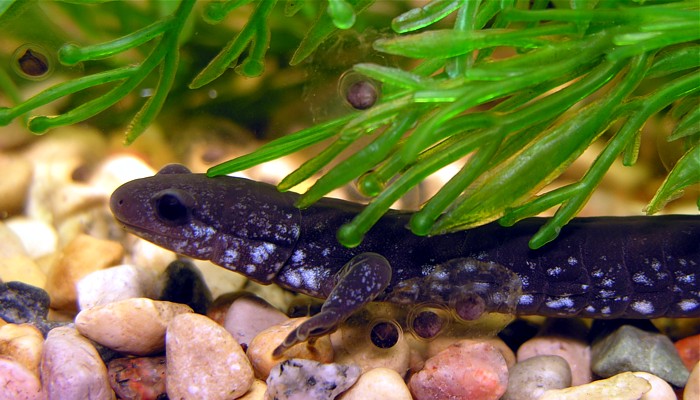
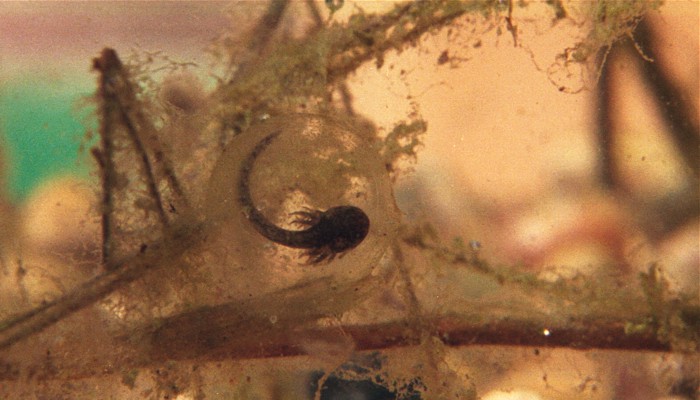
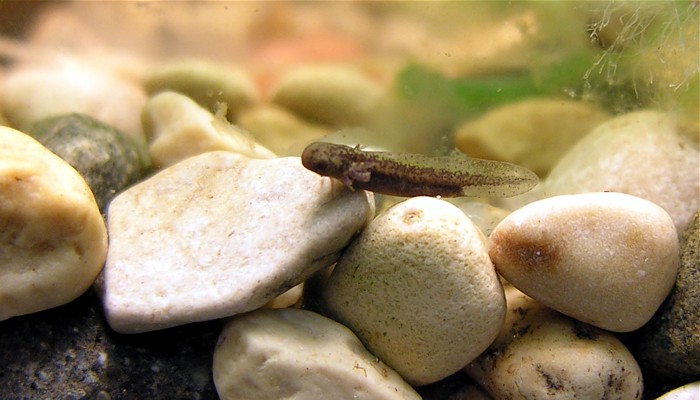
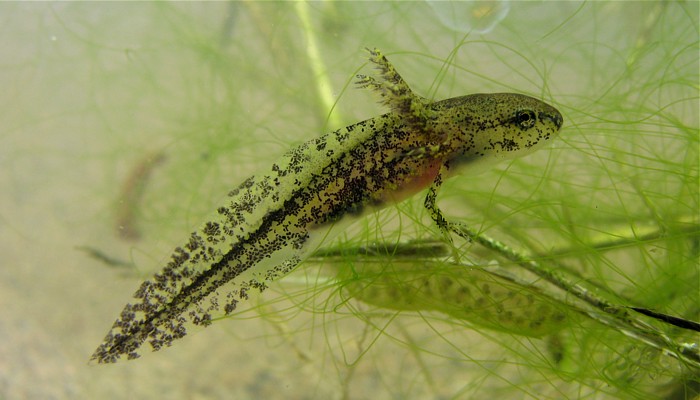
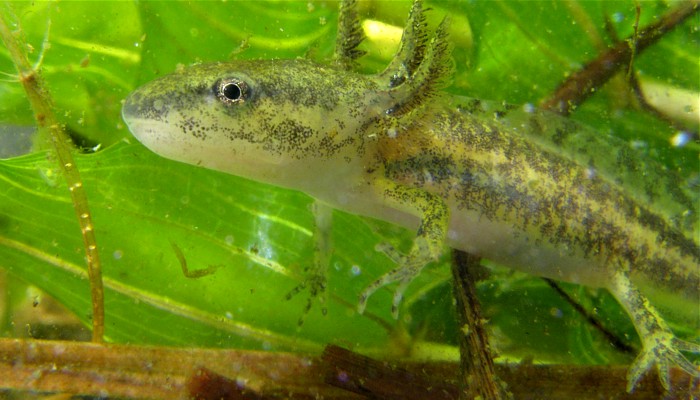
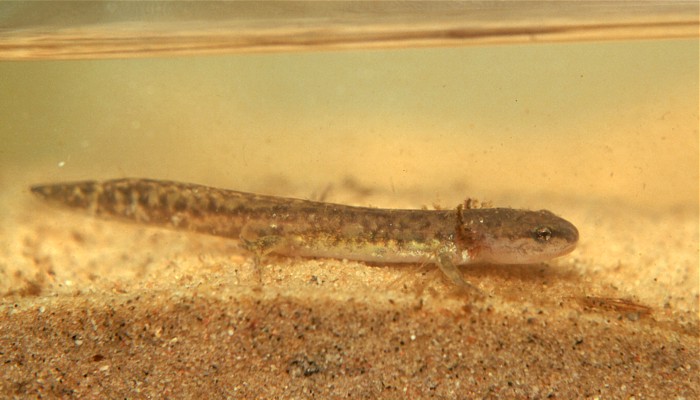
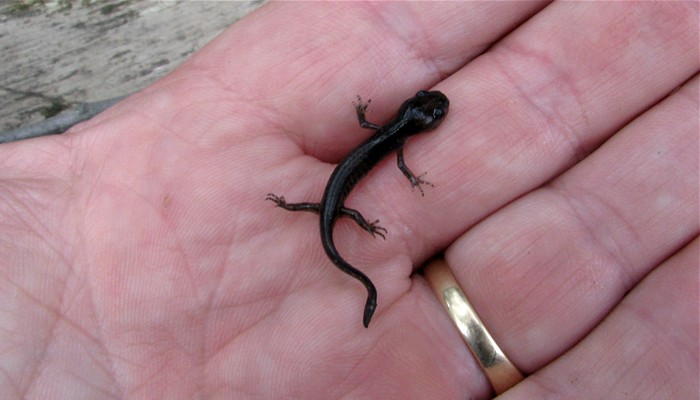
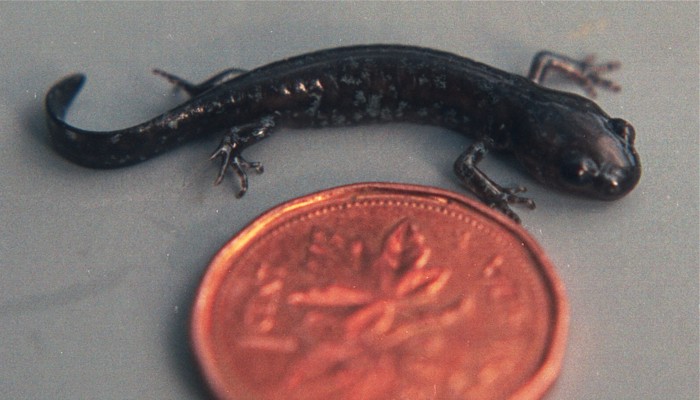
As the larvae get older they look like tiny adult salamanders, except they have broad fins on their tails for swimming, and feathery, external gills. The front limbs emerge when they are about 2 weeks old, and the hind limbs are visible after about 3 weeks of age. Insect larvae and larger aquatic invertebrates are more important in their diet once they reach about 2 cm in length.
They grow to about 3-4 cm in length then transform into adult form and leave the pond, usually by late July to mid-August. Some authors have suggested that the larvae transform when they are 5 cm, to as much as 8 cm long. Like other amphibians, the exact length of time required to reach a size where they can transform, and even the ultimate size they do transform at, will vary with food availability and other conditions. They lose their external gills and tail fins, and gain their adult colouration before leaving the pond. It's thought they require about two years to reach adult size. How long they live for is anybody's guess. Other Ambystomid salamanders can live for more than 10 years.
Really weird stuff: "Boy salamander meets girl salamander, sperm fertilizes egg, new salamander grows up." That's the happy little story of how most salamanders, and most other animals reproduce. But it seems that sometimes Mother Nature gets tired of the same old, same old. So, to keep evolutionary biologists busy, and happy, she occasionally throws a monkey-wrench into things. Here's such a case.
Enter, Tremblay's Salamander
(Ambystoma tremblayi). It occurs at the southern
extent of the Blue-spotted Salamander's range. There are no male Tremblay's
Salamanders, they're all females. Not only that,  they are triploid. That
is, they have three sets of chromosomes, instead of the normal two that most
animals, including we humans have. And they reproduce by parthenogenesis:
the females lay eggs that do not need to be fertilized to start developing
into a new embryo. They do, however, have to mate with a male blue-spotted
salamander to stimulate their eggs to develop into embryos. (Still with
me?) The triploid, all-female Tremblay's Salamanders are sexual parasites
on the Blue-spotted Salamanders. Male Blue-spotted's waste their time
and sperm on the Tremblay's, which are dependent on the presence of the
former species to continue to exist.
they are triploid. That
is, they have three sets of chromosomes, instead of the normal two that most
animals, including we humans have. And they reproduce by parthenogenesis:
the females lay eggs that do not need to be fertilized to start developing
into a new embryo. They do, however, have to mate with a male blue-spotted
salamander to stimulate their eggs to develop into embryos. (Still with
me?) The triploid, all-female Tremblay's Salamanders are sexual parasites
on the Blue-spotted Salamanders. Male Blue-spotted's waste their time
and sperm on the Tremblay's, which are dependent on the presence of the
former species to continue to exist.
How did such a situation come to be? It's thought to have resulted from hybridization of Blue-spotted Salamanders with another physically similar and closely related species, the Jefferson's Salamander (Ambystoma jeffersonianum). The range of these two species overlap in eastern North America, with the Blue-spotted to the north and the Jefferson's to the south. It wasn't until 1964 that it was recognized that they were, in fact, separate species. Interbreeding, combined with incomplete meiosis (meiosis involves the separation of the chromosome pairs to produce egg and sperm cells) somehow resulted in the chance origin of not only the Tremblay's salamander, but also another species, the Silvery Salamander (Ambystoma platineum). Tremblay's has 3 sets of chromosomes, 2 from the blue-spotted and 1 from the Jefferson's, while the Silvery has 2 sets from the Jefferson's and 1 from the Blue-spotted. The Silvery is a triploid all-female sexual parasite of the Jefferson's just as the Tremblay's is of the Blue-spotted. And you thought everything in nature was so well ordered and sensible! Don't turn your back on Mother Nature!
Help NatureNorth produce more great articles:
Carry on for the More Biology of the Blue-spotted Salamander!
Attention all amphibian lovers!If you want to help conserve amphibians in Manitoba then get involved with the Manitoba Herps Atlas! When you find a critter enter a record to help build a province-wide database of species' locations and natural history. |