
Have
You Seen This Bird?
The Eastern Loggerhead Shrike
By the Eastern Manitoba Loggerhead Shrike Recovery Action Group
 If you’re ever walking
through grassland and come across a grasshopper speared on a
twig, don’t assume it was a bad bounce. You’ve
found evidence that you’re sharing habitat with
shrikes!
If you’re ever walking
through grassland and come across a grasshopper speared on a
twig, don’t assume it was a bad bounce. You’ve
found evidence that you’re sharing habitat with
shrikes!
Shrike Seekers Sought!
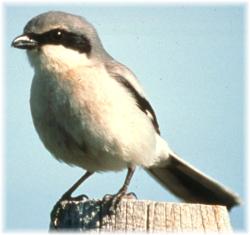
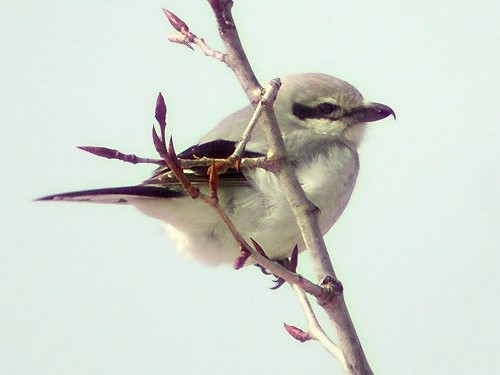
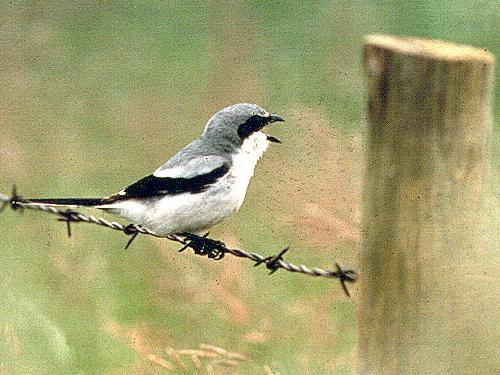
The Eastern Loggerhead Shrike (Lanius ludovicianus migrans) is a grassland bird slightly smaller than a robin. Mostly grey with a white underside, it has white markings on its primarily black wings and tail and a raccoon-like black mask around its eyes. Like its slightly larger cousin the Northern Shrike (see below), the Loggerhead Shrike is a predatory songbird. Because they lack strong talons or claws, shrikes often impale food on branches, thorns or barbed wire fences to help them tear prey into bite-sized pieces. For this meat hanging characteristic, shrikes are often referred to as “butcher birds”. The Loggerhead Shrike’s diet consists primarily of mice, voles, grasshoppers and other insects, while the more predatory Northern Shrike eats a much higher proportion of small rodents and even small birds.
At one time, you could see Eastern Loggerhead Shrikes in Manitoba’s Interlake, south to the American border and east into the Maritimes. A widespread population decline, starting in the 1950s, has reduced their range and numbers to the point that they were listed as Endangered in Canada in 1991 and Endangered in Manitoba in 1998. This means the bird is in imminent danger of being wiped out in much of its former range. (See Manitoba range map.)
Manitoba is for Serious Shrike Spotters!Manitoba is the only province where you can see three different types of shrikes: The Eastern Loggerhead Shrike is an Endangered subspecies of shrike that can be seen from May to September in eastern Manitoba. |
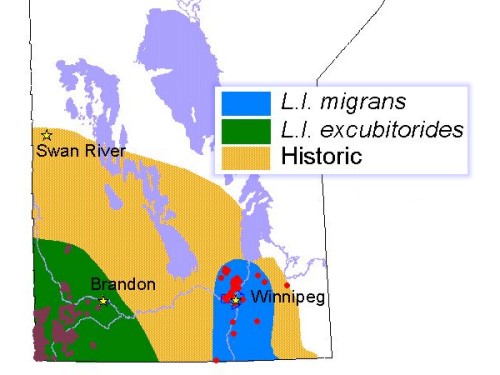
In 2001, at least nine Eastern Loggerhead Shrike pairs were found nesting in Manitoba’s only known breeding area located north of Winnipeg. In an attempt to locate more of the birds in eastern Manitoba, the first volunteer Loggerhead Shrike Survey was conducted in May 2001. Twenty dedicated teams of volunteers covered more than 1,000 km of roads in 20 townships. No new occurrences of the bird were identified, confirming its rarity in the province.
Where to Spot Eastern Loggerhead Shrikes
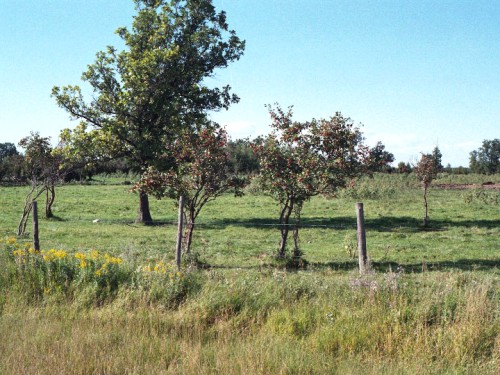 Shrikes
nest in isolated trees and shrubs that grow near mowed areas
or well-grazed grasslands. They are often seen perched on
power lines, fences and other elevated sites in suitable
hunting terrain where they can swoop down on prey. This
swooping behaviour and the attractive grassland habitat of
roadside ditches make Eastern Loggerhead Shrikes especially
vulnerable to collisions with vehicles. Habitat loss and
environmental contamination are also identified as factors
that may directly or indirectly limit populations of the
bird.
Shrikes
nest in isolated trees and shrubs that grow near mowed areas
or well-grazed grasslands. They are often seen perched on
power lines, fences and other elevated sites in suitable
hunting terrain where they can swoop down on prey. This
swooping behaviour and the attractive grassland habitat of
roadside ditches make Eastern Loggerhead Shrikes especially
vulnerable to collisions with vehicles. Habitat loss and
environmental contamination are also identified as factors
that may directly or indirectly limit populations of the
bird.
Saving Shrikes
Monitoring of Loggerhead shrike pairs in southeastern Manitoba has shown that predators and cool, wet weather cause many nests to fail. Young are particularly susceptible to wet weather when they are about a week old. Their growing appetites force parents to spend more time hunting for food and less time in the nest watching over the young. Common predators of eggs and young are other birds like crows or magpies, and mammals like raccoons and cats.
 Monitoring
efforts are teamed with a stewardship and habitat
improvement program being delivered by the Eastern Manitoba
Loggerhead Shrike Recovery Action Group (EMRAG). The mission
of this group is to establish a sustainable population of
Eastern Loggerhead Shrike in Manitoba through:
Monitoring
efforts are teamed with a stewardship and habitat
improvement program being delivered by the Eastern Manitoba
Loggerhead Shrike Recovery Action Group (EMRAG). The mission
of this group is to establish a sustainable population of
Eastern Loggerhead Shrike in Manitoba through:
Cooperative habitat stewardship projects with cattle producers and landowners who have suitable habitat on their propertyVoluntary partnerships with other interest groups and stakeholders; and
Public education on the plight of Loggerhead Shrikes and increased awareness of opportunities to participate in monitoring and management efforts.
To date, 28 Manitoba landowners have voluntarily agreed to enhance Eastern Loggerhead Shrike habitat in cooperation with EMRAG. Similar recovery action groups have been established in Ontario where a larger population remains, and in Quebec where the birds have also occurred historically.
Be a Shrike Steward
 Stewardship
activities that benefit both shrikes and landowners include
fencing out livestock from dugouts and establishing an
alternative watering system; converting cropland to
grassland; implementing a rotational grazing system to
improve grassland quality and provide shrikes with a mosaic
of habitat; and improving shrike nesting, perching and
hunting opportunities by planting isolated trees and shrubs
or shelter-belts in yards or pastures.
Stewardship
activities that benefit both shrikes and landowners include
fencing out livestock from dugouts and establishing an
alternative watering system; converting cropland to
grassland; implementing a rotational grazing system to
improve grassland quality and provide shrikes with a mosaic
of habitat; and improving shrike nesting, perching and
hunting opportunities by planting isolated trees and shrubs
or shelter-belts in yards or pastures.
EMRAG members include the Canadian Cattlemen’s Association, the Manitoba Cattle Producers Association (MCPA), Manitoba Conservation, Manitoba Hydro, City of Winnipeg, Ducks Unlimited Canada, Portage Natural History Society, Prairie Farm Rehabilitation Administration and other interested individuals.
The Eastern Manitoba Loggerhead Shrike Recovery Action Group is tracking occurrences of this rare bird. To report a sighting, learn more about the stewardship program or to participate in the 2002 volunteer survey for shrikes contact one of the following:
The Manitoba Cattle Producers Association (website) at (204) 772-4542Ken De Smet, Manitoba Conservation (email) in Winnipeg at (204) 945-5439
Thanks for learning about Loggerhead Shrikes! Bye for now!
| You can help NatureNorth produce more great articles with a secure donation through PayPal. Our Google Adsense ads pay our server costs, but that's about it. To learn more follow this link: Support NatureNorth. Thank-you! | |
Return to: Spring Issue | NatureNorth Front page