
By Shirley Froehlich (photo's by NNZ)
[View a newer, reformatted version of this article: Blue-eyed Grass.]
Grass with eyes you say? Nonsense! Don't be silly! Next thing I know you will be telling me that we have plants with toes, hair and whiskers, too! But it's true! And their eyes even sparkle with a hint of yellow in the center. Come for a walk with me around my garden or through the prairie in the spring and we are sure to find some of these blue-eyed beauties gazing up at us as we walk by.
Description
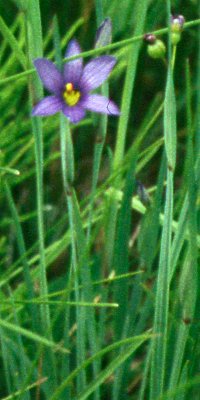 Blue-Eyed
Grass (Sisyrinchium
montanum) can be a shy, retiring plant at times. They
are small perennials, only 10-30 cm (4-12") tall, with
leaves to 3 mm (1/8") wide. They start opening their eyes in
early June and continue to look around all through June. But
you have to be a morning person. Sometimes I have gone to
photograph those pretty blue eyes in the afternoon only to
find that they have already closed their eyes for the day.
And just try to find them when their eyes are closed! Their
medium green grass-like
leaves fade into the background and mingle shyly with
all the prairie grasses around them.
Blue-Eyed
Grass (Sisyrinchium
montanum) can be a shy, retiring plant at times. They
are small perennials, only 10-30 cm (4-12") tall, with
leaves to 3 mm (1/8") wide. They start opening their eyes in
early June and continue to look around all through June. But
you have to be a morning person. Sometimes I have gone to
photograph those pretty blue eyes in the afternoon only to
find that they have already closed their eyes for the day.
And just try to find them when their eyes are closed! Their
medium green grass-like
leaves fade into the background and mingle shyly with
all the prairie grasses around them.
Each pretty blue eye sheds a tear when it is finished blooming, in the form of a small round seed capsule filled with tiny black seeds. Perhaps they are tears of happiness or perhaps they are tears of sorrow. We can only speculate. This plant is also known as Star Grass by some people because the flowers are distinctly star shaped. Blue-Eyed Grass is actually not a true grass, but a member of the Iris family, closely related to Blue Flag or Wild Iris (Iris versicolor).
Native Habitat
Blue-Eyed Grass is a native perennial that grows across the prairies and parklands in open meadows. I have seen it growing in a field in northwest Winnipeg along with Prairie Crocus and Three Flowered Avens. John Morgan (Prairie Habitats - see Gardening with Native Prairie Plants) also reported seeing a hillside covered with blooming plants in the Carberry Hills of Manitoba.
Culture
I got my start in growing Blue-Eyed Grass with the help of some neighbourhood birds, I suspect. I did not have a seed source until I found some plants growing right under my nose in my very own garden. I certainly didn't plant them, so they must have started from seed dropped by the birds. This is a plant that loves full sun and medium to moist soil. It does well in sandy soil with reasonable moisture. It also thrives in my garden in a well drained site of heavy clay soil mixed with some peat moss. In the wild or in a garden setting it self seeds quite easily, but never to the point of being a pest. So if you start with a few plants you may end up with a thriving colony of them in 4 or 5 years. My patch is certainly expanding.
In the garden Blue-Eyed Grass can be planted in sunny flower beds, rock gardens or mixed with other prairie wildflowers and grasses for a prairie meadow. It does well in combination with other small plants such as Pussy Toes, Three Flowered Avens, Lilac Beardtongue, Shrubby Evening Primrose, Upland White Aster, June Grass and Side Oats or Blue Grama Grass. This combination gives a succession of bloom from spring until fall.
The plants can be established either by direct seeding into the garden in October or by setting out plants. Fall seeding naturally stratifies the seed and allows it to begin germination in spring when the weather is still very cool. If the spring weather is very dry, it will be necessary to water the area twice a week to ensure good germination. Plants can be set out in the garden in the spring, as soon as the danger of frost is passed, or in summer. They should bloom the second year from seed.
|
There may be as many as 13 Sisyrinchium species in Canada; their taxonomy is under review (as always). Common Blue-Eyed Grass (Sisyrinchium montanum) has two close relatives in Manitoba: White-Eyed Grass (Sisyrinchium campestre) and Michauxs Blue-Eyed Grass (Sisyrinchium mucronatum). The Editors. |
If you wish to grow your own transplants from seed indoors, seed the trays and stratify in a fridge or cold room for 6 weeks. They will then germinate in 7-14 days under cool conditions of 10-15 degrees C (50-60 F). Normal room temperatures will not work. If you have poor luck germinating them indoors, either save the trays and they will germinate the following spring outside or dump the trays in a place you would like to see them grow and they will germinate in their own time. Plants started indoors in late February will be ready to plant outside in late May.
Final Thoughts
Blue-Eyed Grass is not only a popular and easy to grow wildflower for our gardens, but the birds like to eat the seeds too. And it adds a touch of whimsy to the garden. Oh, and about those other plants with toes and hair and whiskers - You know them don't you? - Pussy Toes, Hair Grass and Old Man's Whiskers (Three Flowered Avens). Give your garden a whimsical theme.
|
Shirley Froehlich runs Prairie Originals, one of Manitoba's native wildflower nurseries. She offers a wide range of plants for sale, including native prairie wildflowers and grasses, as well as some species from forest and wetland settings. Prairie Originals, 27 Bunn's Rd, East Selkirk |
