
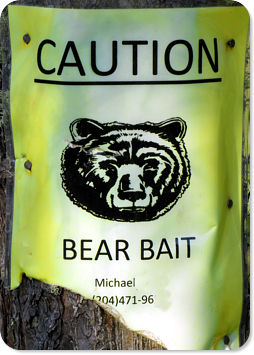
 Bear baiting crosses ethical line.(Published in the Winnipeg Free Press, Jun. 10, 2001) A series of articles in the Free Press last week focusing on bear hunting around Riding Mt. National Park got me thinking about bear hunting in general. Now, I'm no "save the baby seals" type. I fish, I've hunted, I've even trapped. I don't have a problem with the consumptive use of our natural resources, as long as species and habitats are conserved for the future. But I do have a problem with bear hunting as it operates in Manitoba right now. For me its a matter of ethics. And I hear some of you saying "there's no such thing as ethical hunting", but I think the majority of Manitobans respect the tradition of hunting in this province. But the more I think about the facts and issues involved in bear hunting, the more uneasy I feel. Here's my thoughts. How are black bears being hunted? In Manitoba the practice of "baiting" is allowed and that's how all black bears are hunted in this province. People set up bait stations, with grain, spoiled meat or even human foods, well ahead of when they plan to hunt and get the bears accustomed to coming to feed. Then hunters set up tree stands near the bait and wait around to shoot a bear when one shows up. Which bears are being taken? Black bears of either sex may be hunted in Manitoba. Killing female bears with attendant cubs is not permitted, but taking females is allowed if no cubs are visible. Taking females is officially discouraged, but not illegal. Where are they being hunted? Bait stations can be set up on most crown or private lands subject to some restrictions. You have to be at least 30 m from Riding Mt. National Park to set up a bait station to lure bears. Inside Provincial Parks you have to be at least 500 m from cottage developments or picnic areas. Bear hunting is allowed, and is going on right now, in the game bird refuge in the south of Whiteshell Provincial Park, where no bird or deer hunting is allowed. Who is hunting them? Manitobans themselves aren't big bear hunters. Compare these numbers. For the 1996-97 to 1998-99 hunting seasons there were more than 30,000 white-tailed deer harvested annually in Manitoba, and 98% were taken by resident hunters. In the same period roughly 1500 black bears were taken each year, but 70% of these were by non-resident hunters. Manitobans like their venison, but they're not big on bear steaks. Why are they being hunted? Some may be hunted for meat, but most bears killed by non-residents are hunted for sport. That's right, the majority of bears taken in this province are killed so that the hunter can go home with a picture of himself holding the dead bear's head up for the camera. Some people claim hunting helps to control bear numbers and prevent human/bear conflicts. Clearly, the human/bear "conflict" is already a one-sided issue and the bears are losing. Bears attracted to bait stations may learn to associate the scent of humans with food, something that the rest of us try to discourage at our cottages and around picnic areas. Dealing with outfitters, who arrange for tourists to hunt, is a "major time-consumer" for Park Managers and natural resource officers. A few Manitobans make a fair bit of money as guides and outfitters bringing in tourists to kill our bears. While one part of me is little smug about fleecing rich Americans or Germans for the privilege of shooting a bear, I can't quite shake an analogy that struck me the other day. There are other people out there who lure and procure young innocents for the "sport" of others, and you know what they're called. I'm not happy with the notion of prostituting our wildlife to well-heeled tourists just because we can. At some point on the ethical spectrum we all draw our own line. Bear baiting and "sport" hunting are over my line. I'd be ashamed to hunt anything that way and I'm disgusted with killing bears for sport. Got an opinion on bear hunting in Manitoba for the sport of tourists? Then let the Minister of Conservation know how you feel. All Manitobans, rural and urban alike, have a right to participate in decisions made about our wildlife. Thanks for reading! Got to the: < Previous Column | What's Outdoors Front Page | Next Column >
|
||

| You can help NatureNorth produce more great articles with a secure donation through PayPal. Our Google Adsense ads pay our server costs, but that's about it. To learn more follow this link: Support NatureNorth. Thank-you! | |
Return to the: NatureNorth.com Front Page
Or pick a seasonal issue to visit: