
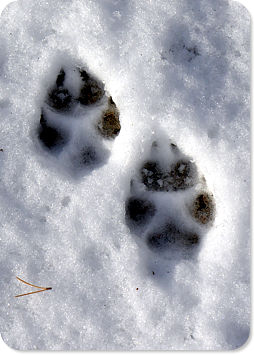
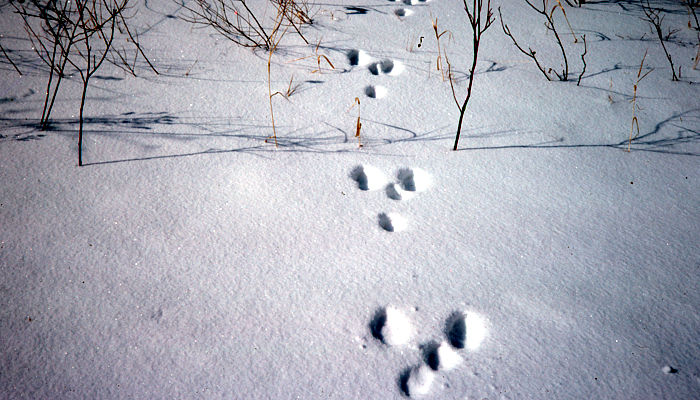
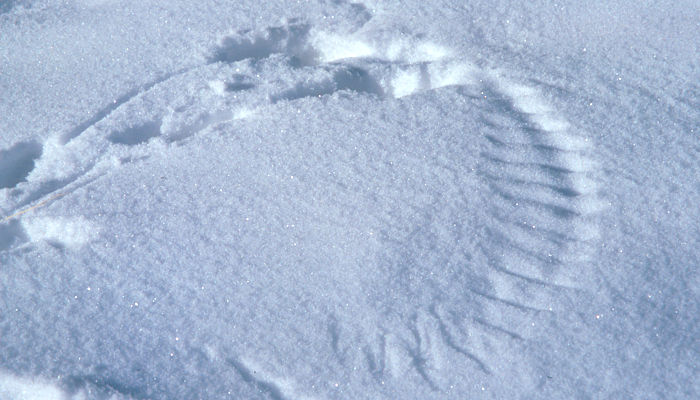
 Tracking can unlock a hidden world.(Published in the Winnipeg Free Press, Dec. 10, 2000) I'm always happy once there's a good covering of snow on the ground. No, I'm not an avid skier or snowmobiler . . . I'm a tracker! One of my favorite winter activities is identifying and interpreting the tracks left by animals in the snow. I was reminded of the importance of tracks in the snow one day last week, on the way back home from my morning trip to the coffee shop. There was a set of fresh foot prints up the walk. Someone had stopped by the door, turned around and left again. When I reached the door, and opened the mail box my suspicions proved correct: the mail carrier had been. A covering of snow is like a pressure-sensitive photographic plate, it records everything that happens to it. Each new snowfall wipes the plate clean, resetting it to start recording all over again. You can use this marvelous feature of snow to glimpse into the lives of animals in winter. Perhaps some experiences I've already had this winter may inspire you to give this new outdoor activity a try. The white jackrabbit I'd seen (and written about) a few weeks ago in my regular dog-walking field, the one that had stuck out like a sore thumb on the brown grass, is now invisible in the snow covered field, but I know it's still around because its tracks are everywhere. There's one spot along the fence where it, and perhaps others, are regularly ducking under as they come and go from the field. From there, a number of separate trails branch out, and there are bare patches where the rabbits have scraped away the snow to eat the grass underneath. In one visit to this snow-covered field, I discovered more about the jackrabbits' daily life than I'd learned from a whole summer's worth of dog walks. Then, on last weekend's trip to our Whiteshell cottage, I was in tracking heaven. I went off by myself for a long afternoon walk down an old logging road. The cloven hoof prints of white- tailed deer were everywhere; their trails through the bush were prominent where they dragged their feet through the shallow snow. At one point a wolf had padded down a section of road, neatly placing it's hind paws into the imprint of the front feet; its trail a business-like straight line, not the silly ambling of a dog. Further on was a smaller set of dog-like tracks belonging to a red fox. A winding trail of bird-like prints revealed a ruffed grouse at one point; it's trail ended abruptly, marked by the tracings of its wing feathers against the snow. At several points red squirrel "highways" criss-crossed the trail, back and forth from tree to tree. Deer mice identified themselves with their long tails dragging in the snow. A vole of some sort had crossed the road at one point, it's trail like a small deer mouse, but without the tail marks. Here and there tiny shrews had alternately hopped over the surface or plowed under the shallow snow, leaving long tunnels. Snowshoe hares, with their enormous hind feet, had bounded along the road in a dozen places. Then, two real "finds": the feet-together bounding gait of a fisher, and then a similar, smaller set of prints, revealing a marten had been by, too. In a couple of hours I'd encountered 12 kinds of animals, though I'd seen only one, a red squirrel chattering at me from a jack pine bough. The tracks they left in the snow were tangible proof of their presence. All that had separated us was time. Making sense of tracks in the snow is not difficult. Identifying the animal that left a particular track is the first step and this requires some practice, but there are a number of good books and web sites around to get you started. The dean of these resources is Olaus J. Murie's A Field Guide to Animal Tracks, No. 9 in the Peterson Field Guide Series; first published in 1954, it is still the standard. If you're looking for a new winter activity, give tracking a try. It's a great way to glimpse into the lives of our all-to-often unseen wildlife, and another way to appreciate our Manitoba winters. Thanks for reading! Got to the: < Previous Column | What's Outdoors Front Page | Next Column >
|
||
|
For more on this topic, here's some articles in NatureNorth.com: Makin' Tracks | Tracks in the Classroom | Tracks in the Snow |
||

| You can help NatureNorth produce more great articles with a secure donation through PayPal. Our Google Adsense ads pay our server costs, but that's about it. To learn more follow this link: Support NatureNorth. Thank-you! | |
Return to the: NatureNorth.com Front Page
Or pick a seasonal issue to visit: