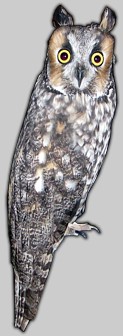
Manitoba’s Nocturnal Owl Survey


Manitoba’s Nocturnal Owl Survey is run under the auspices of Manitoba Conservation.

March 2008 - We're up to date! Jim got us the latest NOS reports and information, so here they are. Watch for the 2008 NOS report next spring. And check out a new Owl Feature in NatureNorth: The Great Gray Owl.

To participate in Manitoba's Nocturnal Owl Survey contact:

Dr. James R. Duncan
Wildlife & Ecosystem Protection Branch
Manitoba Conservation
Box 24, 200 Saulteaux Crescent
Winnipeg, MB R3J 3W3
Email: James.Duncan@gov.mb.ca
You can download the following files:

2008 General Information and Instructions (50 Kb doc file)
2008 Coversheet and Summary Instructions (45 Kb doc file)
2008 Data Forms (110 Kb pdf file)

Learn the owl calls you'll need to participate in the NOS: Manitoba Owl Calls

Download this cool poster, too:

Conserving Canada's Owls (540 Kb pdf file)

To purchase a full size printed version of this poster, contact Jim Duncan at the address above.


2007 Annual Report

Here's the PDF version of the 2007 Nocturnal Owl Survey Report (1.0 Mb PDF).

2006 Annual Report

Here's the PDF version of the 2006 Nocturnal Owl Survey Report (1.0 Mb PDF)
and here's a great poster to download, too: 2006 Results Poster (1.0 Mb PDF).


Manitoba's Nocturnal Owl Survey 2005 Annual Report

By Jim Duncan

Sixteen Years and Still Counting Owls

I am pleased to present the results of the 2005 owl survey. This survey has come a long way since 1991 thanks to hundreds of volunteer owl surveyors! The year 2006 marks the 16th anniversary of this effort.

While the main purpose of the survey was to monitor owls, another equally important goal was to make the conservation of owls a personal experience for many people. The survey has been a success thanks to the interest and participation of volunteers. In addition, much has been learned about owl distribution, their habitat and their status in Manitoba.

The conservation status of all Manitoba birds was reassessed in October 2005 by Manitoba Conservation with assistance from Environment Canada and over 20 naturalists and biologists -- the Manitoba owl survey data was very helpful in providing unique trend and range owl data towards this effort. As in other years, owl survey information and experience has been widely shared with the public, students, other provinces and countries. The Manitoba owl survey is soon going to teach us even more about how to survey for owls.

As some of you recall, the survey used owl call playback for 9 years (1991-1999). Starting in 2000, the survey changed and no playback was used. When the 2008 survey is finished, we will have 9 years of survey data collected without the use of playback and an opportunity to examine the differences in the data obtained using the different survey methods. The future direction of the survey will be decided after a comprehensive review of the data at that time.

Starting in 2006, administration of the Manitoba owl survey will be modified to save time and money. The material and resources needed to conduct the owl survey will be emailed to you, and in the future available on line.

I realize that some current owl surveyors do not have access to email, and I will try to make sure that they may continue to participate. This change was necessary to save time coordinating this extensive survey effort.

Owl Survey Routes and Protocol

In 2005, most owl survey routes were located in southern Manitoba. Listening stations were spaced 1.6 km apart and most surveyors completed 10 stations or multiples thereof. Some routes were sampled more than once on different nights, and all data collected was used in this report. It is important to remember that even surveys in which no owls were heard provided useful information for monitoring owl populations.

2005 Survey Highlights

The Manitoba Volunteer Nocturnal Owl Survey had another successful year with at least 102 volunteers surveying 102 routes (some more than once) covering 1,067 km. Surveyors detected 135 owls or 0.13 owls detected per km surveyed. On average, one owl was detected every 8 km.

Year # Volunteers Distance
Surveyed (Km)
# Routes Total Owl
Detections
# Owl Detections
per Km

2000 106 1085 57 165 0.15
2001 91 1070 57 180 0.17
2002 198 2403 115 315 0.13
2003 162 1776 107 267 0.15
2004 150 1304 94 183 0.14
2005 102 1067 74 135 0.13

As in previous years, the two most abundant species detected were the Great Horned Owl and the Northern Saw-whet Owl (see figure below). The Boreal Owl came in a respectable third. As in most years, no Snowy or Burrowing Owls were detected calling during the survey. Noteworthy is the lack of an increase in the number of Long-eared Owls detected -- it, and the Short-eared Owl, nested in exceptional numbers in southern Manitoba (see picture on the last page) in summer 2005. No Barn, Burrowing or Snowy Owls were detected, although the former is accidental in Manitoba and the timing of the survey is not designed to detect the latter two species.

* OWL SPECIES CODES: NSWO - Northern Saw-whet Owl, GHOW - Great Horned Owl, BOOW - Boreal Owl, BARR - Barred Owl, GGOW - Great Gray Owl, NOHO - Northern Hawk Owl, LEOW - Long-eared Owl, EASO – Eastern Screech Owl. Please also refer to these abbreviations and the following additional species for the charts below: BNOW – Barn Owl and SNOW – Snowy Owl.


The number of owls detected per kilometer over the 15 years since monitoring began in 1991 is shown in the figure below. The gap in the data between 1999 and 2000 represents a change in survey methods (recorded owl call playback was not used after 1999).

The detection rates (number per km) for Great Horned and Boreal Owls dropped this year while those of other species (Barred Owl) increased. Other species, such as the Northern Saw-whet, continue to fluctuate more dramatically over the same period. Great Gray Owls and some other species remained fairly constant. Sharing this information with others may help us learn if these trends are local or more widespread across the species’ North American range.


Many Thanks to all of the Participants and Contributors of the 2005 Survey!

The valuable data collected this past year could not have been possible without the effort and dedication of the volunteer surveyors. Thank you and congratulations! Thanks also to Patsy Duncan for help in preparing mail out material in support of this survey effort.

2005 Nocturnal Owl Survey Volunteers:

Paul Aubin, Ron Austin, Ron Bazin, Jim Bell, Mel Belluk, Robert Berger, Jason Boychuck, Bruce Bremner, Nancy Bremner, Adam Brown, Stan Burt, Tim Byers, William Clark, Barbara Coombs, Kevin Coombs, Renee Delorme, David Doucette, Karen Dudley, Jim Duncan, Patsy Duncan, Bev Dunlop, Richard Dupuis, Alvin Dyck, Vincent Ellin, Dennis Fast, Foster Fournie, Maureen Frolick, Marlene Gifford, Robin Giles, Ruth Giles, Gord Hammel, Harry Harris, Lane Harv, Wally Jansen, Karyn Joliceour, Chuck Karney, Joyce Karney, Kim Kathler, Tim Kathler, Alan Kennedy, Dulcie Kennedy, Ken Kingdon, Gord Kingdon, Rudolf Koes, Paul Koshel, Elizabeth Lansard, Andre Lansard, Georgina Larson, Raymond Larson, Christian Lavergne, Christine Loff, Irene Lyon, Marg Macdonell, Jeannie Mackay, Corinne Mahaffy, Kim Mandzy, Kurt Mazur, Marilyn Meyer, Nancy McLennan, Bonnie McLeod, David McLeod, Ernie McLeod, Ardythe McMaster, Don McMaster, Al Mickey, Lorelie Mitchell, Martha Moffat, Tom Moffat, Wayne Neily, Doug Nichol, Andy Park, Charlotte Pedwell, Morley Pedwell, Barb Pettinger, Ray Pettinger, Tim Plett, Ryan Porteous, David Raitt, Justin Rasmussen, Ken Rasmussen, Robert Regula, Amelia Reid, Calvin Rice, Dave Roberts, Lois Robertson, Barbara Robinson, John Robinson, Kerry Ryan, Len Ryznar, Tom Scott, Rosalie Sigurdson, Hazel Skinner, Ken Tilling, Jason Tilling, Joanne Tuckwell, Dave Uhryniuk, Piet van Dijken, Bill Walley, Jeope Wolfe, Margaret Yorke, Fred Young, and Reto Zach. If you participated in the 2005 owl survey and I did not include your name then perhaps I did not receive your survey results and I sincerely apologize. Please let me know and I will update my records.


Jim Duncan, Manitoba Nocturnal Owl Survey
Wildlife and Ecosystem Protection Branch, Manitoba Conservation
Box 24, 200 Saulteaux Crescent, Winnipeg, MB R3J 3W3

Phone: 204-945-7465, James.Duncan@gov.mb.ca

One of 35 Long-eared Owl nest sites reported to, and visited, in southeastern Manitoba in summer 2005. This was an exceptionally high number of nests reported compared to an average year. Therefore, it is interesting that the Manitoba owl survey did not reveal a corresponding increase in the number of detections for this migratory species in spring 2005.


More on owls in NNZ: Owl Calls | The Great Gray Owl