
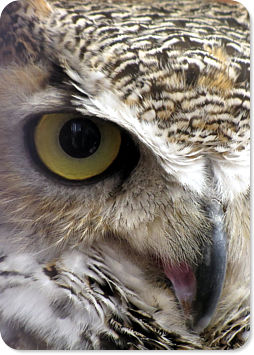
 A "Hoo's Hoo" of Manitoba.(Published in the Winnipeg Free Press, Apr. 22, 2001) It was a sound I will never forget. I'd headed out by myself for a late evening walk at the cottage and stopped to enjoy the silence by the sand pit along an old logging road. All around me was still and dark, no lights, no urban background din; just me and the tall sentinels of the jack pine forest that surrounded me. And then it started. A deep, booming "hoo. . . hoo. . .hoo". A great gray owl was calling into the night, proclaiming its territory and wooing a mate. Enthralled, I drank in the night and this wonderful sound, the voice of this ghost of the boreal forest. Then it stopped as abruptly as it had started. I waited several more minutes, but the owl didn't call again. The moment was over. The owl's call was, to me, more haunting than any distant wolf. I've heard and seen wolves many more times in the Whiteshell than I have great gray owls. The event would also prove to be a haunting reminder of the frustration I've felt over my failure to complete a nocturnal owl survey again this year. For the past 10 years, a large group of volunteers in Manitoba have been engaged in the Nocturnal Owl Survey (NOS). They take advantage of the mating and territorial calls that owls make at this time of year to perform night-time roadside surveys which provide basic information on owl diversity, habitat use and population trends. Surveys are conducted from mid-March to mid-April each year. On an assigned stretch of highway, the surveyors stop at regular intervals, every 1.6 km, listen for two minutes, write down what they heard, or didn't hear, them move on. Each survey includes at least 10 such stops. Of course, you have to know what to listen for. Each of the 12 species of owls that can occur in Manitoba has its own unique call. They don't all just say "hoo, hoo". The NOS provides its volunteers with a cassette of owl calls for them to learn ahead of time, along with detailed instructions and data sheets to fill in. My family heads to the cottage for spring break each year, and as this normally falls within the time frame of the NOS, I plan to do one each year. I managed to take part in the NOS once, several years ago, but have been thwarted in my attempts ever since. Bad weather, sickness and that perennial occurrence at the lake, company, have conspired ever since to thwart my efforts. This year, the 24 hr flu took it's toll. Oh well, maybe next year. Fortunately, there are lots of better organized and more dedicated people involved with the NOS. Over the years nearly 300 individual Manitobans have braved chilly nights in March and April and dark lonely highways to make an important contribution to the base of knowledge about these birds. With all the owl sightings that have made the news this winter, it will be interesting to see the results of the 2001 NOS. As top predators in our ecosystems, owls are important indicators of the health of our natural areas, and basic knowledge about owls is scarce and hard to gather. NOS volunteers are making a significant contribution; their efforts will play a part in the conservation of owls and the management of natural areas. Too many of us take our natural heritage for granted. It's good to see that there are some people who do give a hoot! For more information on Manitoba's Nocturnal Owl Survey, contact Dr. James Duncan, Manitoba Conservation, at (204) 945-7465 (Email Jim Duncan). The calls of Manitoba's owls and some of the NOS results are available online at www.naturenorth.com (direct link below). And if you're not into listening for owls, then how about frogs and toads? Just as NOS time is coming to a close, Manitoba's frogs and toads are getting going with their own nocturnal choruses. And, yes, there is an amphibian monitoring program that works on the same basis as the NOS. (Sorry, Frog Watch Manitoba is no longer working.) You can brush up on your knowledge of the calls of Manitoba's frogs and toads online in Nature North, too. [Update: Frog monitoring is back in business, check out the Manitoba Herps Atlas]. Thanks for reading! Got to the: < Previous Column | What's Outdoors Front Page | Next Column >
|
||
|
For more on this topic, here's some articles in NatureNorth.com: Nocturnal Owl Survey | Manitoba Owl Calls | The Great Gray Owl |
||

| You can help NatureNorth produce more great articles with a secure donation through PayPal. Our Google Adsense ads pay our server costs, but that's about it. To learn more follow this link: Support NatureNorth. Thank-you! | |
Return to the: NatureNorth.com Front Page
Or pick a seasonal issue to visit: