
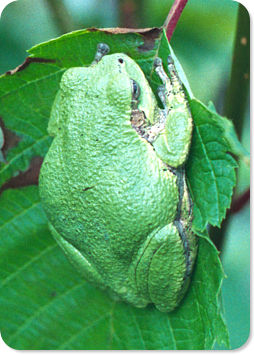
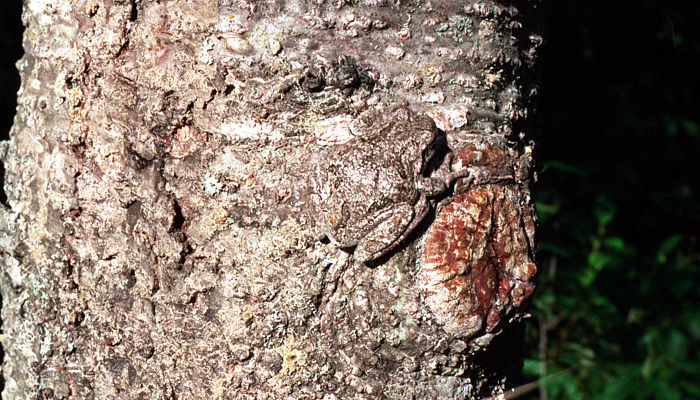
 Treefrogs change colour as needed.(Published in the Winnipeg Free Press, Sep. 16, 2001) What's green, gray or blue, climbs trees, fits in your hand, sticks to glass, and comes in two kinds that you can't tell apart? Why, of course, its Manitoba's chameleons, the Gray Treefrogs! My neighbour at the lake brought me a treefrog last week. It was dark gray at first, but a couple of hours later it was bright green, matching the moss in the aquarium I had put it in, and it inspired me to tell you about one of nature's little secrets. The Gray Treefrog (Hyla versicolor) and Cope's Gray Treefrog (Hyla chrysoscelis) are 2 of the 8 kinds of frogs we have in Manitoba. They're small critters, only about 4 cm in body length, with stout bodies, gangly legs, and long toes tipped with suction pads. Their skin is a bit bumpy and when they sit still with their legs tucked in they look a little like a toad. Some people call them "tree toads". Like chameleons they can change colour to suit their environment. Actually, most amphibians can change colour to some degree. Treefrogs (both kinds) can be anything from bright, lime green to a dark charcoal gray, and any shade in between. They can be solidly coloured or streaked and blotched with darker greens or grays. They can change colour completely in a matter of an hour or two. So where does the blue come in? Treefrogs, like some other Manitoba frogs, spend winter frozen solid on the forest floor. When they are frozen their skin has a bluish caste to it. Both treefrogs are found in southern and central Manitoba, with the Gray more prominent in the east and Cope's dominating in the west, but their ranges do overlap east of Winnipeg. True to their names, treefrogs do live in trees and bushes. Mainly nocturnal, they are expert climbers and they forage in shrubs and treetops for moths and other insects to eat. They climb nimbly about the branches using their long legs and sticky toe pads to adhere to all sorts of surfaces. They really can stick to, and climb up, glass windows. I've often found them on the windows of phone booths hunting for moths attracted to the lights. Now, to the business of these 2 different species of animals looking identical. Really, you can't tell them apart by looking at them. In one of the weirder quirks of nature, what distinguishes the Gray Treefrog from the Cope's Gray Treefrog is the number of genes it has. If you recall your high school biology you know that most animals have their genetic material in the form of sets of chromosomes. We humans have 46 chromosomes, 23 pairs. Each pair has the genes for similar traits. Copes Gray Treefrog has its chromosomes in pairs, like us, and is said to have a diploid chromosome number. The Gray Treefrog is tetraploid, it has its chromosomes in sets of 4 not in pairs. How does that work? After all, in humans even a slight change in chromosome numbers causes serious problems. Down's Syndrome is caused by having 3 of chromosome #21. Well . . . I don't know how it works, and I doubt if anybody else does either. It's a bizarre twist of nature, but not something that's been well researched. For whatever reason multiples of 2 works, in frogs and toads at least, but not odd numbers of chromosomes. There are even octaploid frogs in South America, with chromosomes in 8's! Somewhere back in time the Gray Treefrog arose spontaneously out of Cope's Treefrog by some meiotic accident, the sex cells didn't separate their chromosomes properly in one or more mating pairs. The 2 are really the same animal, the Gray is just an unintentional copy of the Cope's. If the 2 try to mate they produce triploid offspring, chromosomes in 3's, and these aren't viable. Natural selection has kept the 2 separate and they have evolved a way of telling each other apart by having different mating calls. It's enough for each to distinguish the other, so there was no need to have evolved physical differences to separate the species. Mother nature is full of surprises and lots of them are right here in Manitoba. Thanks for reading! Got to the: < Previous Column | What's Outdoors Front Page
|
||
|
For more on this topic, here's some articles in NatureNorth.com: |
||


| You can help NatureNorth produce more great articles with a secure donation through PayPal. Our Google Adsense ads pay our server costs, but that's about it. To learn more follow this link: Support NatureNorth. Thank-you! | |
Return to the: NatureNorth.com Front Page
Or pick a seasonal issue to visit: