
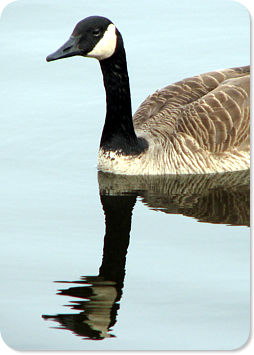
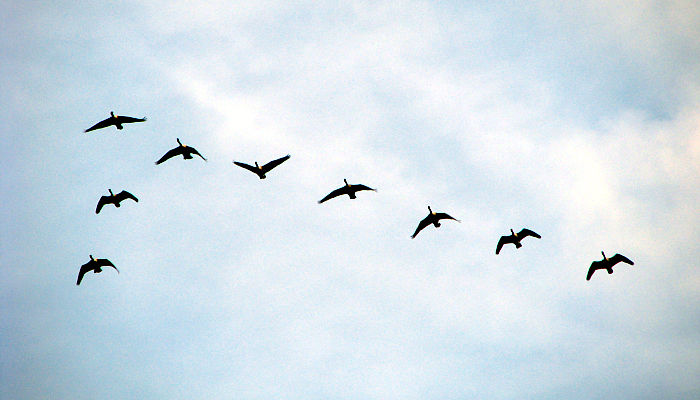
 Snowbirds go further south than our geese.(Published in the Winnipeg Free Press, Nov. 12, 2000) OK, hands up, who knows where our Canada geese go for the winter? And by our geese, I mean just the ones that come to Manitoba in summer to breed. Now, hands down, all of you who were going to say "south" or anything else as vague, like "the States" or "Central America". Don't know? Well, neither did I until last week. Like so many of you, I took it for granted that Canada geese flew south for the winter, and I didn't think about it any further. They're most obvious to us in southern Manitoba during their spring and fall migrations, when large flocks rest and feed along the way north or south. But once they're out of sight, they're out of mind. I didn't know where the geese went, but I knew who would, so I called up Murray Gillespie and Garth Ball, waterfowl specialists at the Wildlife Branch, Manitoba Conservation and asked them. Here's what they told me. Each spring, nearly half a million Canada geese arrive in Manitoba to breed. By autumn there may be one and a half million birds, parents and their young, ready to head south. (Natural and hunting mortality will trim the numbers back by the time they return again.) But they don't all go to the same place. There are many different populations of Canada geese in North America. Each population has its own breeding and wintering grounds, and the birds are pretty faithful to these. Geese mate for life, and have a strong urge to return to where they were born to raise their own young. Young birds learn the migration routes and the location of the wintering and breeding grounds from their parents and other adult birds. And it's on the wintering grounds that young birds find their mates from within their own population. So, the populations don't mix much. Five different populations of Canada geese have all or part of their summer breeding grounds in Manitoba. The furthest south that any of these goes in winter is southern Illinois. The Eastern Prairie population, that breeds as far north as Churchill, can travel as much as 2400 km to winter in the region around Swan Lake Refuge in Northern Missouri. The Mississippi Valley population, that breeds around York Factory, also travels up to 2400 km, concentrating for the winter near the Horseshoe Lake Refuge in southern Illinois. The Western Prairie Population, which breeds in western Manitoba, travels about 1600 km to southeastern South Dakota and northeastern Nebraska. The Rock Prairie population spends summer in southeastern Manitoba; the geese at the Alf Hole Sanctuary in Rennie belong to this group. They fly only about 1000 km to the Rock Prairie Refuge in southern Wisconsin. And finally, the Interlake-Rochester population breeds in the Interlake and winters near Rochester in southeastern Minnesota, traveling only about 1000 km as well. The geese usually wait for the weather here to turn bad - heavy snow and marsh-freezing cold - before leaving. They also take advantage of favourable winds to make their long migration flights. If they can couple their 60 km/h air speed with a 40 km/h tail wind, that's 100 km/h ground speed. There are records of the Interlake Population making the trip to Rochester overnight! Why only that far south, why not all the way to the Gulf of Mexico? Well, why go any further than you have to? Geese aren't like human snowbirds, looking for warm weather get-aways. Migration is expensive for them. It is a heavy tax on their annual energy budget. The geese only travel as far as they have to, to reach open water and available food. Open water affords protection and the waste grain in farm fields provides ample food. Once on the wintering grounds, the geese focus on loafing around, conserving energy. Feeding sorties are interspersed with lots of inactivity and plenty of sleep through the long winter nights. Some populations of Canada geese used to winter much farther south than they do now, and human activities may be the reason this has changed. Modern farming practices, which result in lots of waste grain; industrial activities, like power plants that keep water bodies open; and hunting pressure, a serious disincentive to going further than necessary; have shifted the wintering grounds of some populations further north. Have human activities altered more than just where the geese overwinter? What about their numbers and the impacts that millions of geese are having on their and our environments? How would you like a million and a half geese descending on your locality for the winter? A little more on goose numbers and their impact in another column. [Update: Which I never did write back then, guess I shoud do one soon!] Thanks for reading! Got to the: < Previous Column | What's Outdoors Front Page | Next Column >
|
||

| You can help NatureNorth produce more great articles with a secure donation through PayPal. Our Google Adsense ads pay our server costs, but that's about it. To learn more follow this link: Support NatureNorth. Thank-you! | |
Return to the: NatureNorth.com Front Page
Or pick a seasonal issue to visit: