
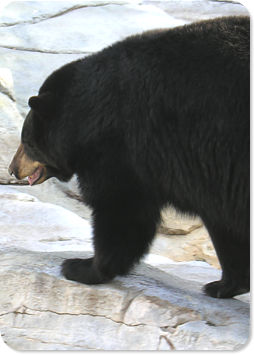
 Nature knows the bear facts of survival.(Published in the Winnipeg Free Press, Nov. 19, 2000) As part of our bedtime ritual, I'm sure all of us include a trip to the bath room. Imagine settling down for a six month long sleep without having to worry about getting up to go pee! Our black bears do it every year. Yes, by now the friendly Whiteshell bears that insist on trashing my cottage bird feeders have packed it in for the winter. On a gravelly hillside they've excavated a den and settled in. They will sleep the winter away; they won't eat, drink, urinate or defecate until they wake up next April. Bears hibernate, not because they can't deal with the cold, but because they are unable to find enough food at this time of year. They are omnivores, feeding on green vegetation, roots, seeds, nuts, berries, insects, small animals and carrion. In our temperate climate these kinds of food are abundant in late summer and autumn, then scarce over winter. The bears take advantage of the abundance to store food as body fat. They can put on 10 kg of fat a week and may increase their total weight by 30% before hibernation. As winter approaches food becomes scarce, so their stomach and intestines empty out before they den up. The intestinal tract can largely shut down for winter. Not so for the kidneys and other organs. Hibernating black bears reduce their metabolism, the sum total of the physiological processes that sustain life, to about 30% of normal summer levels. Their heart rate drops from 60 beats per minute down to around 10 beats per minute. Body temperature drops only about 7 C, to around 30 C. Even with their reduced metabolism, their large size, thick coat and cozy den limits any further drop in temperature. The hibernating bear's metabolism is fueled almost exclusively by its store of fat. The chemical break down of fat releases energy and other nutrients. The byproducts are CO2, which is exhaled, and water; an added benefit to offset the bear's losses to evaporation and breathing. Very little protein is metabolized. Protein breakdown results in the accumulation of a toxic byproduct, urea. All mammals produce urea and it is carried via the bloodstream to the kidneys where it is filtered out and excreted with the urine. (Humans with kidney disease must rely on dialysis machines to clean their blood of urea and other compounds.) Hibernating bears produce very little urea and, rather than having to excrete it, have found a way to recycle it. There is some urine produced, but the water and urea diffuse back out of the bladder into the bloodstream. The urea is taken up by bacteria inside the bear's gut and converted into amino acids and ultimately back into proteins available for the bear to use again. All during hibernation the bear's body is attending to other functions, some normal, others quite extraordinary. Besides not having to go to the bathroom, bears wake up in the spring with healthy muscles and bones. (A human bed-ridden for 6 months would suffer from muscle atrophy and loss of bone mass, and would be unable to get out of bed.) Blood cholesterol is very high in hibernating bears, but they don't seem to suffer from arteriosclerosis, hardening of the arteries, nor do they develop gall stones. To top it off, female black bears gestate, give birth and nurse their young during this period! All this within a closed system - the bear's own body - operating solely on fat and oxygen for 6 or even 7 months. Come spring, bears emerge from their dens lean and hungry, but fit, with nearly the same fat- free body mass they had going into hibernation; though for females some of that has been turned into cubs! The implications of understanding what bears do and applying it to humans are staggering. On the fanciful end of things, there is the possibility of real "suspended animation" for long space voyages. On the more down to earth side, there are certain to be medical applications for this knowledge, in the fields of kidney and heart disease, osteoporosis, muscle atrophy related to disease or injury and so on. Mother Nature has had millions of years to find solutions to all sorts of problems. There are answers out there, if we're smart enough to know where to look. Thanks for reading! Got to the: < Previous Column | What's Outdoors Front Page | Next Column >
|
||

| You can help NatureNorth produce more great articles with a secure donation through PayPal. Our Google Adsense ads pay our server costs, but that's about it. To learn more follow this link: Support NatureNorth. Thank-you! | |
Return to the: NatureNorth.com Front Page
Or pick a seasonal issue to visit: