
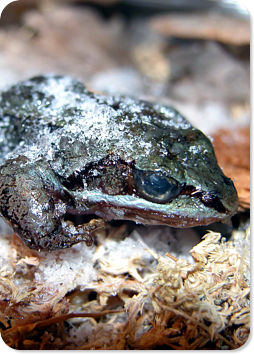
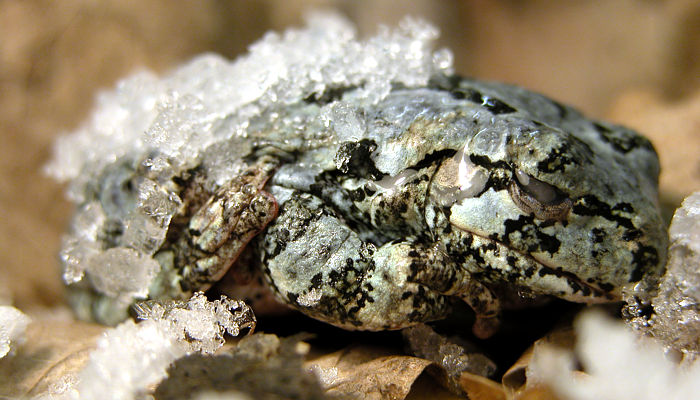
 Some frogs hibernate, some become "frog-cicles".(Published in the Winnipeg Free Press, Feb. 4, 2001) It's the middle of winter, do you know where your frogs are? And by that I mean, do you know where Manitoba's frogs are right now? I know where my personal frogs are . . . in the fridge, but I'll get to that later. There are 15 species of amphibians that make Manitoba their home: 8 different frogs, 4 toads and 3 salamanders. Amphibians are surprisingly long-lived creatures, provided they don't get eaten by something else, and some kinds may live 10 to 20 years, surviving many winters in the process. We tend to see them and think about them only during the warm months of the year, but where do they go and what do they do to get through our Manitoba winters? It turns out there are a variety of answers to those questions, depending on which species you are talking about. One group of amphibians uses the "deep water" technique to over-winter. When temperatures start to fall in autumn some frogs: the leopard frog, mink frog and green frog, head for the bottom of ponds and lakes. There they will sit, inactive, sometimes partially buried in the mud, breathing by taking oxygen in through their skin. They are dependent on water deep enough not to freeze to the bottom, and that will maintain at least a minimal concentration of oxygen. This places limits on where these kinds of frogs can live. When spring melts the ice and warms the water, these frogs resume their regular lifestyles. Another amphibian that spends winter in deep water, the mudpuppy (a large aquatic salamander), doesn't even hibernate. Mudpuppies stay active all year and are occasionally caught by people ice-fishing. Another group of amphibians hibernate on land, but they head below the frost-line to avoid the worst cold. In autumn, our 4 toads: the American, Canadian, great plains and plains spadefoot, burrow down into soft soil, using their hind feet like shovels. They must often go a metre or more below the ground to find a frost-free sanctuary. Our other two salamanders, (blue-spotted and tiger), also make their way down below the frost-line for winter, but they prefer to use abandoned burrows or other natural holes rather than digging their own. The loss of reliance on large bodies of water for overwintering means all these guys can live farther from permanent water. However, this group and the "deep-water" amphibians have something in common: if they freeze, they die. Then there's another bunch of amphibians, all frogs, that employ a pretty amazing trick to get through winter. The wood frog, boreal chorus frog, spring peeper, gray treefrog and Cope's gray treefrog don't bother to avoid the cold; they freeze solid and survive! As winter approaches, these frogs find a comfy spot on the forest floor, under some leaves or beneath a log, or under matted grass in a meadow, and just sit there. Next to the ground, with a protective blanket of snow above, the temperatures can often remain above freezing for much of the winter. But eventually they will dip below 0C. When this occurs the frogs are ready, for they arm themselves with antifreeze to protect their body tissues. Cold itself is not what harms living tissues and kills animals; it's the formation of ice crystals that tear up individual cells in tissues, causing death. These frogs flood their cells with glucose, a natural body sugar. This prevents the formation of ice-crystals, similar to what windshield washer antifreeze does in your car. Yes, right now, woodlands and meadows throughout Manitoba are littered with "frog-cicles"! These freeze-tolerant amphibians have all but lost their reliance on large bodies of water. If they can find a small temporary pond in the spring, one that will last about 8-10 weeks, long enough for their tadpoles to grow and transform to froglets, then their species can survive there. Oh yeah, I mentioned my frogs in the fridge. I keep a variety of local amphibians as pets and for use in some educational programming that I do. When food for them gets scarce in the fall, I pop them into the fridge for the winter, where they sit out winter as they would in the wild. My wife has learned to read the labels of all suspicious containers! Thanks for reading! Got to the: < Previous Column | What's Outdoors Front Page | Next Column >
|
||
|
For more on this topic, here's some articles in NatureNorth.com: |
||

| You can help NatureNorth produce more great articles with a secure donation through PayPal. Our Google Adsense ads pay our server costs, but that's about it. To learn more follow this link: Support NatureNorth. Thank-you! | |
Return to the: NatureNorth.com Front Page
Or pick a seasonal issue to visit: